

PMU for Cancer Survivors: Restorative Techniques in Dubai

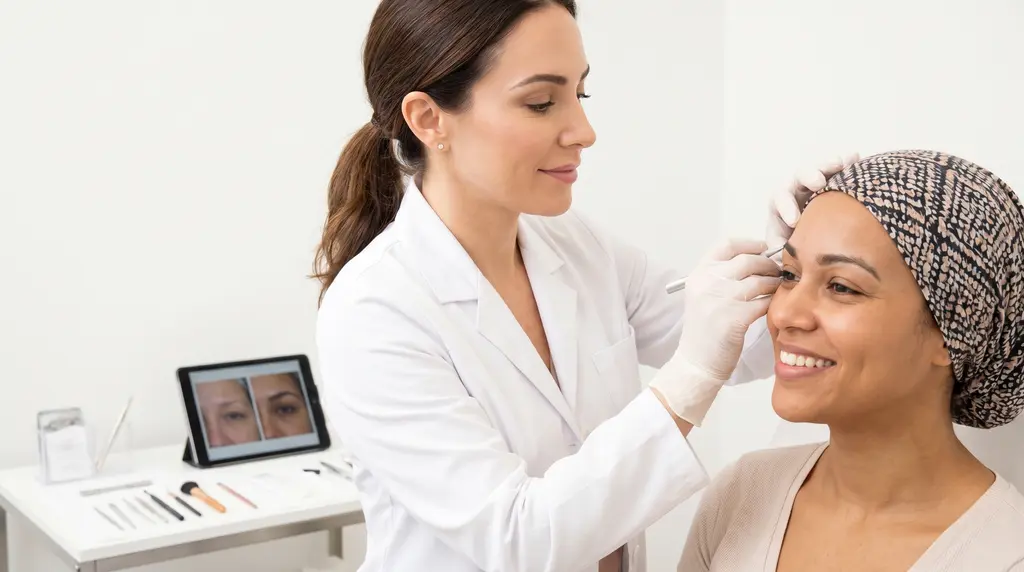
PMU for Cancer Survivors is one of the most popular permanent makeup treatments at Brows & Lips Studio Dubai. When Nadia walked into our Dubai studio last spring, she removed her hijab and revealed eyebrows that were barely there. Not from over-plucking or a bad wax—but from chemotherapy. “I look in the mirror and don’t recognize myself,” she said softly. “I don’t want to look like I did before cancer. I just want to look like me again.” That sentence has stayed with me through every PMU session I’ve done for cancer survivors since then. Because that’s what this work is really about: not making someone look “better,” but letting them recognize the person in the mirror.
At Brows & Lips in Dubai, we’ve had the privilege of working with dozens of cancer survivors over the years—women from across the UAE, Saudi Arabia, and beyond who have faced one of life’s toughest battles and are now reclaiming their appearance on their own terms. Restorative PMU isn’t like standard permanent makeup. It’s a different process, a different mindset, and a profoundly different emotional experience for everyone involved.
What Makes Restorative PMU Different
Standard PMU is about enhancement—making good features even better. Restorative PMU is about reconstruction. Cancer treatments like chemotherapy and radiation can cause complete hair loss not just on the scalp, but also on the eyebrows and eyelashes. Those brows that frame your face? Gone. The lashes that protect your eyes? Sometimes gone permanently. Surgical procedures like mastectomies leave scars that some women want to camouflage.
The techniques we use for restorative work are fundamentally different from cosmetic PMU: PMU for Cancer Survivors offers beautiful, natural-looking results.
- Gentler pigment placement: Cancer survivors often have more sensitive skin post-treatment. We use softer implanting techniques and hypoallergenic pigments that are gentler on compromised skin.
- Custom structural design: When there’s no natural hair to work around, we have to rebuild the entire brow structure from scratch, using facial bone landmarks and the client’s own photos from before treatment as a guide.
- Color matching for scarred or irradiated skin: Skin that has undergone radiation therapy can have a different texture and undertone. We pre-test pigment reactions on small areas before committing to full work.
- Shorter, more frequent sessions: Healing can be unpredictable on post-treatment skin. We prefer lighter applications over multiple sessions rather than one heavy session.
The golden rule we follow: less is always more. We can always add more pigment in a touch-up session, but removing too much from a survivor’s face is emotionally devastating.
Areola Restoration: The Procedure Nobody Talks About
Breast cancer is the most common cancer among women in the UAE, and Dubai’s world-class medical facilities attract patients from across the region. After mastectomy and reconstructive surgery, many women are left without areolas—a daily reminder of what they’ve been through that’s visible every time they look in the mirror.
Farida, a 42-year-old Emirati teacher and mother of three, came to us after her double mastectomy and reconstruction. “My husband tells me I’m beautiful, and I believe him,” she told me. “But when I get dressed, I don’t want to see what was removed. I want to see something that looks like it’s always been part of me.”
Areola restoration using medical PMU is one of the most rewarding procedures we do. We use specialized micropigmentation techniques that create a three-dimensional illusion of the areola and nipple—complete with subtle color variations, natural shadowing, and even Montgomery gland textures. The pigments we use are specifically formulated for medical applications and remain stable on scar tissue.
The session itself is deeply emotional. Most of our areola restoration clients have been through months or years of treatment. They’ve been poked, prodded, scanned, and operated on. They’re done with medical procedures. But this one is different—this one is about finishing, about closing the chapter. I’ve had clients cry when they saw the result for the first time. I’ve cried with them.
Scar Camouflage: Addressing the Visible Battle Scars
Cancer treatment scars come in many forms—surgical scars from biopsies and mastectomies, port-a-cath scars from chemotherapy delivery, radiation marks that never fully fade. These are proof of survival, yes, but they’re also daily visual reminders that can be draining.
Scar camouflage for cancer survivors requires an entirely different toolset. The scar tissue has a different density, different blood supply, and different pigment retention than surrounding skin. We use:
- Micropigmentation paramedical technique — implanting pigments layer by layer to match the surrounding skin tone
- Color theory correction — neutralizing the red, purple, or white discoloration common in surgical scars
- Textural blending — using different needle configurations to create a surface texture that mimics the surrounding skin
- Serial light sessions — building coverage over 2-4 sessions rather than attempting full coverage in one go
We assess scar maturity before proceeding. A scar needs to be at least 12 months old, fully healed, and no longer undergoing changes before we can begin camouflage work. For clients who are still undergoing treatment or have just finished, we recommend waiting until their oncologist confirms their skin is stable.
Emotional Preparation and Aftercare
Working with cancer survivors requires more than technical skill—it demands emotional intelligence and cultural sensitivity, especially here in Dubai where family dynamics and community perceptions play a significant role in a woman’s recovery journey.
We always offer the following to our restorative PMU clients:
- Consultations without obligation — we sit and talk before any needles come out. Some clients come three or four times before they’re ready to proceed.
- A private room for sessions — no open studio floor. Privacy is paramount, especially for areola restoration work.
- Flexible scheduling — we understand that oncology appointments take priority. We work around your treatment schedule.
- Accompanied sessions — you’re welcome to bring your husband, sister, or friend. We have comfortable seating for companions.
What Our Survivor Clients Tell Us
Aisha, a 35-year-old Dubai-based architect diagnosed with breast cancer at 32, shared this a few weeks after her areola restoration: “When I look at myself now, I don’t see cancer first. I see me. It’s not that I’ve forgotten what happened—I never will—but I don’t have to see it every single morning. That mental load was real.”
Mariam, a Syrian mother of two who lost her brows during chemo for Hodgkin’s lymphoma, told us: “In our community, people talk. They look at you. I was tired of wearing a cap and sunglasses everywhere. After my brows were done, I walked into a family gathering and my aunt said ‘Welcome back, habibti.’ Nobody mentioned my illness. They just saw me again.”
Elena, a Russian expat living in JLT who had brow restoration and scar camouflage, said through tears: “I spent 18 months being a patient. I was good at it. But I was ready to stop being a patient and start being a woman again. This was the first step that felt like mine. Not a doctor’s recommendation. My choice.”
Medical Clearance and Safety
Important: We follow strict medical protocols for restorative PMU. Before any procedure, we require written clearance from your treating oncologist or physician confirming that:
- Your cancer treatment is complete or at a stable maintenance phase
- Your skin at the treatment site is fully healed
- Your blood platelet count and healing factors are within normal ranges
- You have no active infections or immunosuppression concerns
We’re not a medical facility—we’re an aesthetic studio that specializes in restorative techniques. We work with your medical team, not instead of them. Our studio follows all Dubai Health Authority (DHA) regulations for medical PMU procedures, including sterilization protocols that exceed standard requirements.
Is Restorative PMU Right for You?
If you or someone you love is a cancer survivor considering restorative PMU in Dubai, here’s my honest advice:
- Don’t rush. If you finished treatment last week, give yourself time. Your body is still healing in ways you can’t see.
- Ask questions. A good restorative PMU artist will answer every single one without impatience.
- Trust your gut. If a studio rushes you or makes you feel uncomfortable, walk away. This is your body and your journey.
- Bring a support person. The session can bring up unexpected emotions. Having someone there helps.
The women who come to us for restorative PMU are some of the strongest people I’ve ever met. They’ve fought battles most of us can’t imagine. Our role isn’t to “fix” them—they’re not broken. Our role is to help them see the reflection they recognize, the one that was always there, just waiting to come back into focus.
At Brows & Lips in Dubai, we’re honoured to be part of that journey. If you’d like to learn more about our restorative PMU services, book a no-obligation consultation. No needles, no pressure—just a conversation about what’s possible.
Note: Client names have been changed to protect privacy. All results vary by individual. Medical clearance from an oncologist or treating physician is required before any restorative PMU procedure at our studio.
Explore our restorative PMU and our approach at Brows and Lips Studio Dubai.