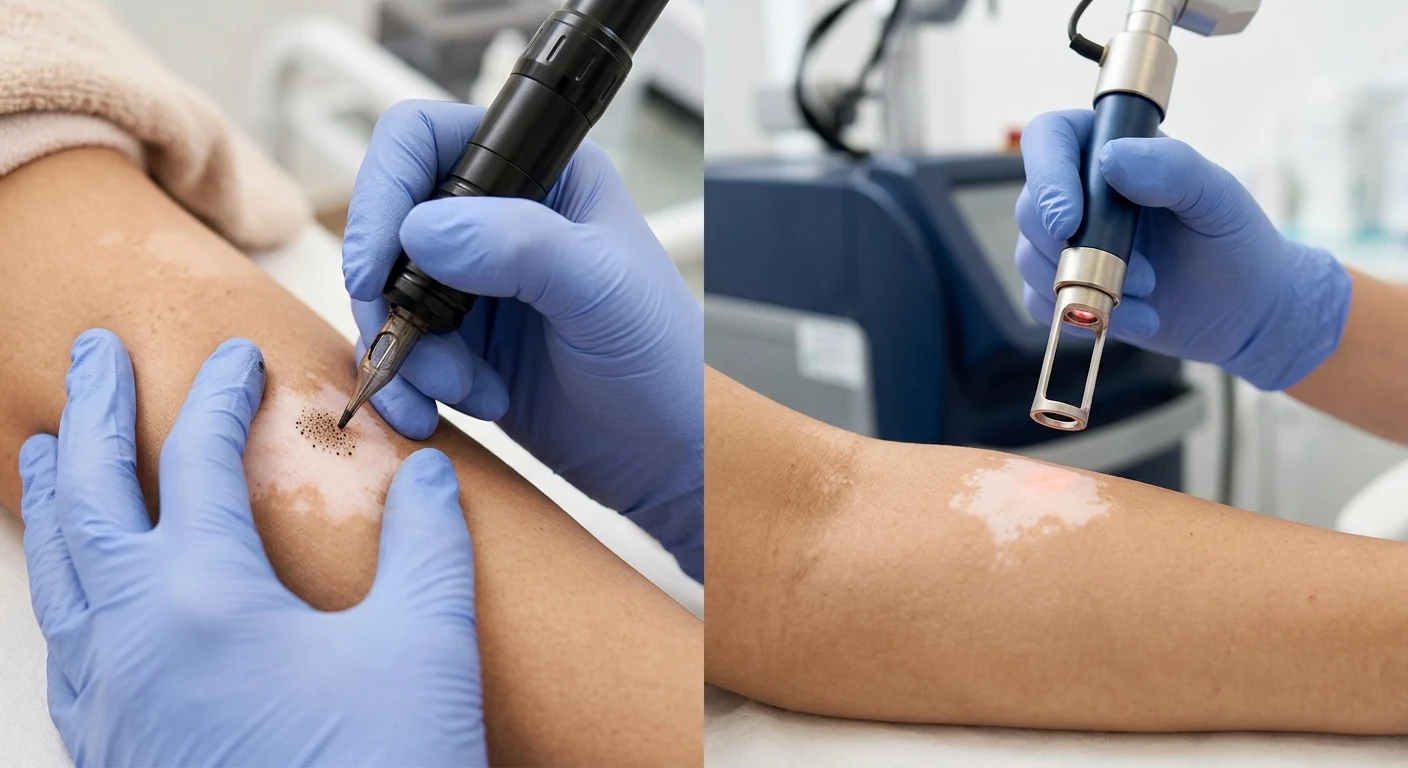
What the Two Options Actually Do
Clients researching vitiligo pigment camouflage Dubai clinics often arrive thinking laser and tattoo are competing versions of the same treatment. They are not. They target the depigmented patch from opposite directions, and the choice between them depends less on marketing than on the stage your vitiligo is at and how much downtime you can afford.
Medical tattoo camouflage deposits a custom-mixed pigment into the depigmented patch so it visually matches the surrounding skin tone. The goal is even colour. It does not treat vitiligo itself, and it does nothing to stop new patches appearing elsewhere. Laser repigmentation works in the opposite direction: it tries to wake up the skin's own melanocytes inside the white patch so the body repigments from within. The goal is to restore the skin's natural pigment machinery.
Vitiligo Pigment Camouflage Tattoo: How It Works
A vitiligo camouflage session at a Dubai medical-PMU studio follows the same structure as a scar camouflage tattoo, but the colour-matching step is the entire point of the treatment.
- Mapping and shade mixing, 30 minutes. The artist measures the patch, photographs it under daylight and a controlled colour booth, and mixes a custom pigment from a base set of medical-grade iron-oxide-free pigments. The shade is built up in layers, not selected from a chart.
- Patch test on a sub-area, optional but recommended. A small spot inside the patch is tattooed first. It is reviewed at four to six weeks to confirm the colour settles to the surrounding tone before the full area is committed.
- First full session, 60 to 90 minutes. Pigment is implanted with a digital machine at a controlled depth into the dermis. Most clients describe it as a light scratching rather than pain, with stronger sensation on bony areas (knuckles, elbows, ankles) than on softer skin (face, neck, torso).
- Refining session at six to eight weeks. Camouflage pigment often heals twenty to thirty percent lighter than the day it was placed, and the true skin-matched tone only becomes visible after the second session. A third session is occasionally needed on deeper skin tones or sun-exposed areas where the pigment warms slightly during healing.
Our guide to vitiligo camouflage tattoo walks through the day-by-day healing process, and the aftercare page covers the first two weeks in detail.
Laser Repigmentation for Vitiligo: How It Works
Dermatology clinics in Dubai offer two main laser families for vitiligo repigmentation. They are not interchangeable — the type chosen depends on patch location, stability, and skin tone.
- Excimer laser (308 nm). A targeted ultraviolet-B beam that stimulates dormant melanocytes in the patch. The most established option for small, stable patches on the face, neck, and torso. Sessions are twice a week for eight to sixteen weeks.
- Fractional non-ablative laser (1540, 1550 nm). Creates micro-channels in the skin that improve the delivery of topical agents and trigger a melanocyte response. Often combined with topical 5-fluorouracil or topical JAK inhibitor. Used for larger patches and for acral areas (hands, feet) where excimer alone tends to underperform.
- Fractional ablative laser (CO2, 10,600 nm). Reserved for resistant patches and for combining with melanocyte transfer (mini-grafting). Has more downtime — five to seven days of redness and peeling — but can be effective on stable, long-standing patches.
The honest result range for laser repigmentation is wide: roughly fifty to seventy percent of stable patches show meaningful repigmentation after a full course, but the repigmented tone is often a few shades lighter than the surrounding skin, and spotty rather than uniform. A second laser course is usually needed for full blending.
Side by Side: Camouflage Tattoo vs Laser
The decision matrix below is the one we walk through in our own consultation room when a client is choosing between the two.
Result timeline
- Camouflage tattoo: visible result from session one, full match after one to three sessions over three to six months.
- Excimer laser: first visible pigment at six to twelve weeks, full course takes three to six months of twice-weekly visits.
- Fractional laser: visible pigment at eight to sixteen weeks, full course four to eight months.
Stability requirement
- Camouflage tattoo: works regardless of whether vitiligo is active or stable, because it does not rely on the skin's melanocytes.
- Excimer and fractional laser: requires at least six to twelve months without new lesions or expansion of existing patches. Active vitiligo wastes the treatment.
Cost in Dubai (2026)
- Camouflage tattoo, small patch (under 25 sq cm): 800 to 1,200 AED per session, two sessions typical.
- Camouflage tattoo, mid-size (25 to 100 sq cm): 1,200 to 2,500 AED per session.
- Camouflage tattoo, large or multi-area: 3,000 to 6,000 AED per case, quoted after consultation.
- Excimer laser: 400 to 700 AED per session, twenty to forty sessions per course.
- Fractional laser (with topical agent): 1,500 to 3,000 AED per session, six to ten sessions per course.
Longevity
- Camouflage tattoo: three to five years before a colour refresh, longer on areas with low UV and friction.
- Laser repigmentation: can last years when the melanocyte response re-establishes, but new vitiligo patches can still appear elsewhere on the body.
Downtime per session
- Camouflage tattoo: mild redness for 24 to 48 hours, flaking at five to seven days, no real downtime beyond avoiding sun, pool and gym for ten to fourteen days.
- Excimer laser: mild pinkness for twelve to twenty-four hours, no peeling.
- Fractional laser: two to seven days of redness, peeling, and strict sun avoidance depending on the device.
One decision shortcut. If your vitiligo has been stable for over a year and the patch is on the face or torso, laser has a meaningful chance of working. If the patch is acral (hands, feet, lips), active, or you need a visible result for an event in the next three months, camouflage tattoo is almost always the right call.
Who Each Option Is Right For
The framing below is what we use when triaging vitiligo camouflage consultations at our Al Wasl studio.
Camouflage tattoo is the better fit when
- The patch is stable in size but you want it gone visually this year.
- You have an event, a wedding, a holiday, or a work deadline that laser repigmentation cannot meet on its own timeline.
- The patch is acral (hands, feet, lips, elbows) where laser is known to underperform.
- You have tried laser and the response was incomplete or uneven.
- Your skin tone is deeper, where the camouflage pigment is built warm and the visual blend is faster than waiting for melanocyte repigmentation.
Laser is the better fit when
- Vitiligo has been stable for twelve months or longer and the patch is on the face, neck, or torso.
- You are under thirty and the melanocyte reserve is still biologically active.
- The patch is relatively new (under two years) and small to mid-size.
- You are willing to commit to twice-weekly clinic visits for three to six months.
- You want the skin to repigment with its own biology rather than carry a tattoo pigment for years.
Can You Combine the Two?
Yes, and in our experience a combination approach gives the most natural result on patches that did not fully respond to laser. The usual sequence is:
- Stage one, laser first. Eight to sixteen weeks of excimer or fractional laser to coax whatever natural repigmentation the melanocytes will give.
- Stage two, camouflage second. After the laser course is complete and the skin has rested for three months, a camouflage tattoo session evens out the patchy or partial response.
- Stage three, optional touch-up. Six to twelve months later, a short touch-up on the camouflage if the blend has shifted slightly with sun exposure.
This sequencing works because laser needs intact, calm skin to respond, and camouflage pigment needs a stable base to settle into. Running both at the same time on the same patch produces uneven results and risks pigment disturbance.
What Camouflage Pigment Looks Like Over Time
The biggest worry clients raise is whether the colour will hold, shift, or look obviously tattooed. Three honest answers:
- Colour shift is rare when the pigment is iron-oxide-free and skin-tone mixed. Most camouflage tattoos we see at the studio five years later still read as skin, not pigment. Cheap iron-oxide pigment does shift, which is why reputable clinics use medical-grade lines specifically formulated for vitiligo.
- Sun exposure fades the edges first. The centre of the patch, which is usually covered by clothing or shielded by daily SPF, keeps its colour longest. The borders, which catch the most UV, soften first. Annual SPF 50 on the area keeps the blend even for years.
- Tattoo removal is possible but rarely needed. If the camouflage tone does shift because the surrounding skin tanned, a saline removal session can lift it without the scarring risk of laser tattoo removal. Most clinics quote 600 to 1,200 AED for a small-area removal.
Choosing a Dubai Clinic for Either Option
The clinic checklist below applies whether you choose tattoo or laser, and the same caution applies to both.
- Ask to see healed photos at three to twelve months, not just day-one results. Fresh camouflage and fresh laser both look better than the healed result. A clinic that only shows day-one shots is hiding something.
- Ask which pigments and which laser device the clinic uses. Reputable studios name the brand (Perma Blend, Li Pigments, Evenflo for tattoo; XTRAC excimer, Fraxel Dual for laser). A vague answer means a generic product.
- Confirm the medical oversight. Vitiligo is a medical condition. The clinic should at minimum take a history of stability, ask about photosensitising medication, and refer you to a dermatologist if vitiligo is active or recently progressing.
- Check the patch-test policy. Any camouflage clinic worth booking will offer a small test area inside the patch before committing to a full session. This is non-negotiable on the face.
- Quote per session, not per package. Camouflage response varies. Pay per session and stop when the colour matches, rather than committing to a three-session package that may not be needed.
Frequently Asked Questions
Is pigment camouflage the same as vitiligo tattoo?
Yes. Vitiligo pigment camouflage is the medical-tattoo form of camouflage PMU — pigment is implanted into the patch to match the surrounding skin. It evens the tone visually but does not treat vitiligo itself.
Which works faster, laser or camouflage tattoo?
Camouflage tattoo is faster to a visible result — usually one to three sessions over three to six months. Laser repigmentation takes three to six months of twice-weekly sessions, and not every patch responds.
How much does vitiligo camouflage tattoo cost in Dubai?
Small patches start around 800 AED per session, mid-size patches run 1,200 to 2,500 AED, and large or multi-area cases are quoted at 3,000 to 6,000 AED. Most patches need two sessions for a stable match.
Is laser repigmentation permanent?
Repigmentation can last years once melanocytes re-establish, but active vitiligo can still produce new patches elsewhere. Laser works best on stable vitiligo confirmed by at least six months without new lesions.
Can you combine camouflage tattoo with laser treatment?
Yes. Many Dubai dermatologists sequence laser first to encourage natural repigmentation, then camouflage tattoo second to even patches where the laser response was incomplete. Space the two at least three months apart on the same area.
Does vitiligo camouflage tattoo fade?
Slower than cosmetic PMU because the pigment is placed deeper and matched to skin tone. Expect three to five years before a refresh, longer on covered or low-UV areas.
Book a Vitiligo Camouflage Consultation in Dubai
If you are weighing the two options, start with a consultation rather than a booking. We assess the stability of your vitiligo, photograph the patch under controlled lighting, discuss whether a dermatologist should be involved first, and recommend the option we genuinely think will serve you better — including, when appropriate, referring you out to a laser clinic. Visit the vitiligo camouflage service page for what to expect, or browse the full service list to compare options. For adjacent medical-PMU work like surgical scar and stretch mark blending, see our scar camouflage service.