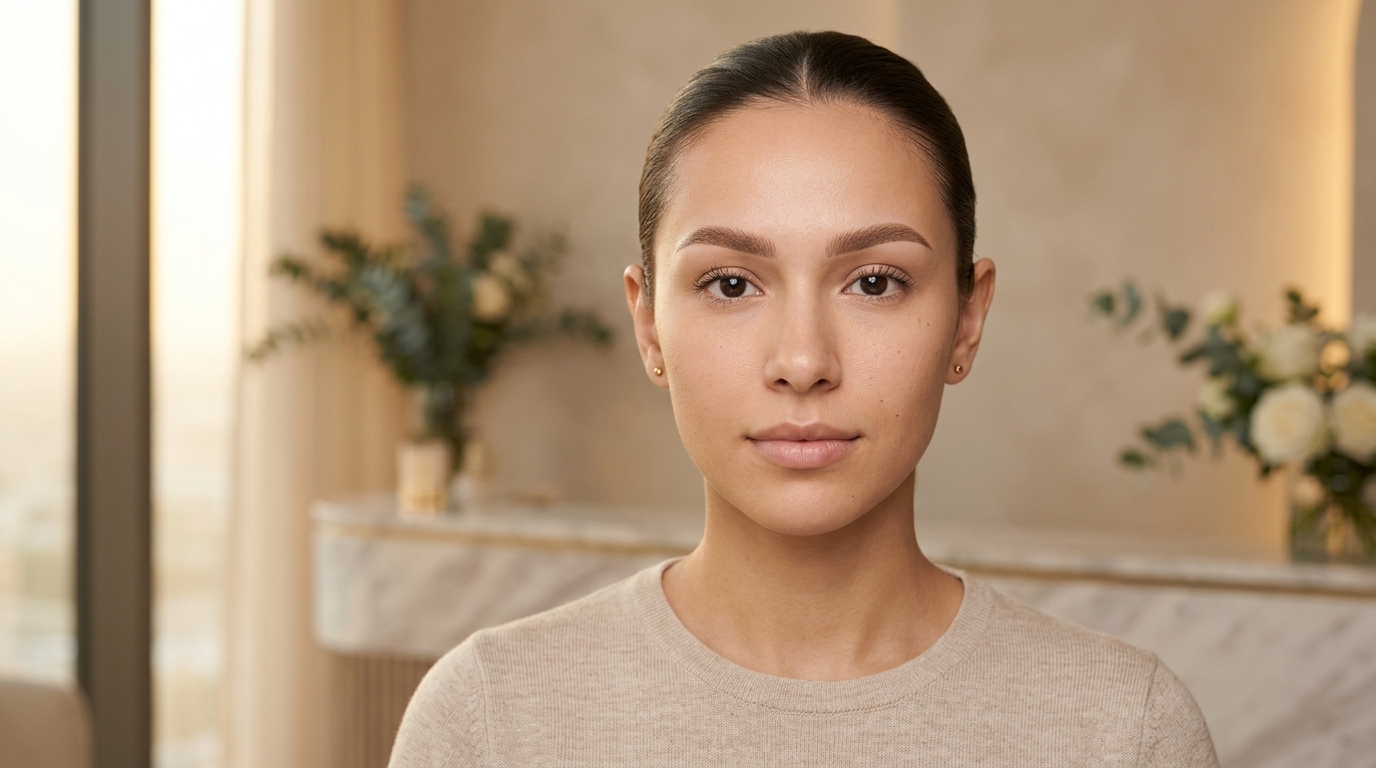
Microshading eyebrows is the powder brows technique built around controlled dot-work shading rather than individual hair-strokes — it deposits a soft, pixelated gradient of pigment into the upper dermal layer using a single-needle or 3-round configuration and produces a soft, filled-in brow that reads as makeup rather than as natural hair. In Dubai’s DHA-licensed studios, microshading has become the most-booked eyebrow PMU technique for clients who want a defined but soft brow without the daily pencil — and the 2026 market treats it as a distinct procedure from microblading, nano brows, and powder brows, not as a generic term for “soft brows.”
This guide covers the technique in depth: how manual hand-tool microshading differs from machine microshading, how the needle configuration affects the pixel density, what pigment selection looks like in DHA-licensed studios, the day-by-day healing arc from session to 6-week touch-up, realistic 2026 Dubai pricing across studio tiers, and the specific client profiles microshading is built for. If you are weighing microshading against nano brows, the nano brows Dubai guide covers the hair-stroke comparison separately.
The Powder Brows Technique: What Microshading Actually Does
Microshading is a specific eyebrow tattoo technique that uses a dot-pattern implantation method to build a pixelated color gradient. Each “pixel” is a single, controlled puncture that deposits a micro-dose of pigment into the upper dermis (roughly 0.5 to 0.8 mm depth). When the dots are placed close together at the brow body and spaced farther apart at the edges, they produce a soft gradient that reads as filled-in brows with a powder finish — the technique that gave the method its common name.
Manual Hand-Tool Microshading
Manual microshading uses a hand-held tool (no machine) with a single-needle or 3-needle round cartridge. The artist controls depth and pressure entirely by hand, with no motor. Manual microshading is the original technique — it produces the softest pixel pattern and is preferred for dry, mature, or sensitive skin where machine vibration can over-stimulate the tissue.
- Best for: Mature clients (40+), sensitive skin, dry skin, first-time PMU clients
- Needle config: Single-needle (1-round) or 3-needle round, manual pressure
- Pixel density: Soft to medium — 6 to 10 pixels per square millimeter at the brow body
- Session length: 2 to 2.5 hours
- Pigment deposit per dot: Lower than machine, requires 2 to 3 passes per zone
Machine Microshading
Machine microshading uses a rotary or digital PMU machine with a 1-round or 3-round needle cartridge, vibrating at 100 to 180 cycles per second. The machine produces a more consistent pixel size and allows denser dot patterns than manual work. Machine microshading is preferred for oily or thick skin, where the machine’s consistent depth cuts through the oil barrier and creates more uniform saturation.
- Best for: Oily skin, thick skin, clients who want a denser, more saturated look
- Needle config: 1-round or 3-round cartridge, 100 to 180 Hz
- Pixel density: Medium to dense — 10 to 16 pixels per square millimeter at the brow body
- Session length: 1.5 to 2 hours
- Pigment deposit per dot: Higher than manual, often 1 to 2 passes per zone
Why the needle configuration matters: A 1-round needle produces a finer, softer pixel pattern — ideal for the brow front where you want the gradient to fade out. A 3-round needle produces a denser, more defined pixel pattern — ideal for the brow body and tail where you want stronger color. Most DHA-licensed Dubai studios use both during a single session, switching cartridges to build the gradient.
Pigment Selection: How DHA-Licensed Studios Match Your Skin Tone
Microshading pigment is not a single color — it is a custom blend of 2 to 4 base pigments mixed at the studio to match your skin’s undertone, your natural hair color (current, not childhood), and your desired brow intensity. Dubai studios that work with DHA-licensed pigment lines (BioTouch, Perma Blend, Li Pigments, Swiss Color) will document the exact mix ratio in your file so touch-ups at year 2 or year 3 reproduce the same color.
Three Rules That Govern Pigment Selection
- Cool undertone clients (pink, red undertones in the skin): Add a green or ash modifier to the warm base pigment to neutralize the red and prevent the healed color from shifting toward salmon or orange.
- Warm undertone clients (yellow, golden undertones): Use the warm base pigment with minimal or no modifier — the skin’s natural warmth pushes the color toward yellow if it is not balanced.
- Olive or neutral undertone clients: Use a 60/40 or 70/30 warm-to-cool blend, tested against the inside of the wrist where the undertone is most visible.
Pigment Depth, Not Pigment Brand, Drives Longevity
The single biggest variable in how long microshading lasts is how deep the pigment was implanted — not which brand the studio used. A studio using a premium DHA-licensed pigment but implanting too shallow (0.3 mm) will see 40 to 60 percent fade by month 6. A studio using a budget pigment but implanting at the correct 0.5 to 0.8 mm depth will see 20 to 30 percent fade by month 6. Ask your Dubai studio what depth they target per zone — if they cannot answer, book elsewhere.
The Microshading Procedure Step by Step
A DHA-licensed microshading session in Dubai takes 1.5 to 2.5 hours depending on the manual-vs-machine path and whether you are a first-time client or returning for a touch-up. Below is the exact step-by-step that any reputable studio follows, in the same order, with the time per step a first-time client should expect.
1. Consultation and Brow Mapping (30 to 45 Minutes)
The artist measures your face using the golden ratio (1.618) and three reference points — nose bridge, nose center, and nose corner — to map the brow start, arch, and tail. They draw the shape with a cosmetic pencil and adjust based on your natural brow growth, your preferred arch height, and your lifestyle (low-maintenance clients go slightly fuller; high-makeup clients go slightly more defined). You approve the shape before any pigment touches the skin.
2. Pigment Selection and Patch Test (15 to 20 Minutes)
The artist mixes 2 to 4 pigments to your custom shade and swatches them next to your natural brow hair. If you have a history of pigment reaction, they perform a patch test behind the ear and wait 24 to 48 hours before the full session. Most Dubai studios skip the patch test for clients with no prior PMU history — but will perform one on request.
3. Numbing (20 to 30 Minutes Onset)
A topical anesthetic cream (typically 5% lidocaine + 2.5% prilocaine, or a stronger 10% tetracaine blend for sensitive clients) is applied and left on for 20 to 30 minutes under plastic wrap. Most Dubai studios re-apply during the session if you start feeling sensitivity — microshading is less painful than microblading because the needle does not drag across the skin, but the cumulative dot-work on the brow body can feel intense without re-application.
4. Shading Application (45 to 75 Minutes)
The artist builds the brow from tail to front: the densest pixel pattern at the tail (where you want the most definition), medium density at the body, and the lightest pattern at the front (where you want a soft, faded gradient). For manual microshading, this is 2 to 3 passes per zone with the 1-round or 3-round hand tool. For machine microshading, 1 to 2 passes per zone with the cartridge. The session ends with a final wipe and review.
5. Aftercare Briefing (10 Minutes)
The studio provides an aftercare balm (typically Bepanthen or a DHA-approved equivalent), printed aftercare instructions, and the date for your 6-week touch-up. You leave the studio with the brows looking 30 to 50 percent darker and more saturated than the final result — this is normal and expected.
Day-by-Day Healing: 6-Week Microshading Recovery
Microshading follows a 6-week healing arc that ends at the touch-up session. The first 14 days are the visible healing phase (scabbing, peeling, color bloom); weeks 3 to 6 are the quiet phase where the pigment stabilizes in the dermal layer and the final tone settles. Below is the day-by-day timeline with what to expect and what to avoid.
Day 1 to 2: Saturation and Mild Swelling
Brows look 30 to 50 percent darker than the final result because the surface pigment is mixed with lymph fluid. Mild swelling around the brow bone is normal. Apply the aftercare balm every 3 to 4 hours, do not wet the brows, and sleep on your back with a clean pillowcase.
Day 3 to 5: Peeling and Chapping Phase
The surface pigment begins to lift off as the skin renews. Brows feel tight, dry, and start to flake in small, pixel-sized pieces — do not pick. Color appears 40 to 60 percent faded during this window, which is the most common reason clients panic. This is normal; the pigment in the dermis is intact and will bloom back during week 2.
- Day 3-4: Visible flaking, color at 40 to 60 percent intensity, no picking
- Day 5: Most flaking has cleared, color appears faded and uneven
- What to avoid: Hot showers on the brow, sauna, swimming, heavy exercise that produces facial sweat, retinol or AHA products near the brow
Day 6 to 14: Color Bloom and Stabilization
The healed pigment comes back to the surface as the dead skin clears. Color rises from the 40 to 60 percent faded state to 70 to 90 percent of the original saturation. By day 14, the true tone is visible for the first time — this is what your final brow color will be until the 6-week touch-up refines the shape.
Week 3 to 6: Quiet Healing Phase
No visible changes occur during this window, but the pigment is locking into the dermis and the body is metabolizing the excess. Some clients see a slight fade (5 to 10 percent) during week 4 to 5 as the body settles the pigment — this is normal and is corrected at the 6-week touch-up.
Week 6: Touch-Up Session
The 6-week touch-up is where the artist refines the shape, fills any zones where pigment took lightly, and locks in the final color. Without the touch-up, microshading fades 20 to 40 percent faster than the studio’s quoted longevity and can develop uneven patches. Most Dubai studios include the touch-up in the initial price or charge 500 to 800 AED.
Day-by-day rule of thumb: If the color looks faded on day 5, do not panic — the pigment is in the dermis and will bloom back. If the color looks faded on day 14 and you are NOT booked for a touch-up, contact the studio. Day 14 is the earliest point at which a real touch-up decision can be made.
Microshading Cost in Dubai Studios (2026)
Microshading is priced in the middle tier of Dubai eyebrow PMU — more than microblading (1,000 to 1,500 AED) because the session is longer and the technique is more pigment-intensive, but less than nano brows (1,800 to 2,800 AED) which require advanced hair-stroke skill. The 2026 price ranges below are DHA-licensed studio averages across Al Barsha, Jumeirah, Dubai Marina, Downtown, and Business Bay.
2026 Microshading Price by Studio Tier
- Senior artist (10+ years, DHA-licensed, premium studio): 1,800 to 2,200 AED initial, 500 to 800 AED touch-up
- Mid-tier artist (5 to 10 years, DHA-licensed): 1,400 to 1,800 AED initial, 400 to 700 AED touch-up
- Junior artist (1 to 5 years, DHA-licensed): 1,200 to 1,500 AED initial, 300 to 600 AED touch-up
- 6-week touch-up: Included or 300 to 800 AED depending on studio tier
- Annual color refresh (year 2 to 3): 800 to 1,400 AED — a single session to restore faded color
What Drives the Price
- Artist experience. DHA licensing is the floor; senior artists command 40 to 60 percent more than junior artists because they can correct asymmetry, work on mature or oily skin, and customize the pigment mix with more precision.
- Pigment brand. DHA-licensed pigment lines (Perma Blend, Li Pigments, Swiss Color) cost the studio more than generic pigment and are reflected in the price. Avoid studios that will not name their pigment brand.
- Studio overhead. Premium studios in Jumeirah or Downtown charge 20 to 30 percent more than studios in Al Barsha or International City for the same artist skill, because of rent.
Who Microshading Is Built For
Microshading is the right technique for clients who want a filled-in, defined brow with a powder finish and who have skin that takes pigment uniformly. It is NOT the right technique for clients who want visible hair-strokes (those need nano brows) or for clients with very oily or very dry skin (those need technique modifications). Below are the four client profiles microshading is built for, and the profiles it is not.
Best Fits
- Sparse natural brows with normal-to-dry skin: Microshading builds the brow body and tail with a soft, even pigment that reads as filled-in rather than tattooed.
- Over-plucked brows in the regrowth phase: Microshading covers the gaps while the natural hairs regrow, and the final look is a blend of natural hair and pigment.
- Active lifestyle (gym, swimming, hot yoga): Microshading holds its shape through sweat and water exposure better than microblading because the pigment is in dot form rather than line form.
- Mature clients (40+) who want a defined brow without daily pencil: Manual microshading is the gentlest option for mature skin and produces a soft, age-appropriate finish.
Poor Fits
- Very oily skin (uncontrolled): Even with machine microshading, very oily skin can blur the pixel pattern within 6 to 12 months. Powder brows for oily skin tips covers technique modifications that help, but the longevity may still be shorter than for normal skin.
- Clients who want visible hair-strokes: Microshading produces a pixel gradient, not hair-strokes. If you want the nano brow look, see the nano brows technique instead.
- Clients with active skin conditions (eczema, psoriasis, dermatitis on the brow): The condition must be controlled for at least 6 months before microshading. Talk to your DHA-licensed studio about a consultation patch test.
Microshading vs Powder Brows vs Ombre Brows: How They Relate
The Dubai market uses the terms microshading, powder brows, and ombre brows somewhat interchangeably, but they refer to specific points on the same spectrum. Below is how DHA-licensed studios in 2026 typically define each.
Microshading
The broadest term — any technique that uses dot-work implantation to build a pixelated gradient. Includes both manual and machine methods. The most common interpretation in Dubai studios.
Powder Brows
Synonymous with microshading in most Dubai studios. Some studios use “powder brows” specifically for the machine method with a denser pixel pattern, and “microshading” for the manual method with a softer pixel pattern. The technique overlap is high.
Ombre Brows
A specific sub-style of microshading/powder brows with a defined gradient from light at the front to dark at the tail. The pixel density is highest at the tail and lowest at the front. Ombre brows are a shape choice, not a separate technique.
What to ask the studio when booking: “Is your microshading done manually or with a machine, and what pixel density do you target at the brow body vs the brow front?” A DHA-licensed studio will answer in specific terms. If they cannot, that is a signal to book elsewhere.
Common Mistakes When Booking Microshading in Dubai
Three mistakes come up repeatedly in Dubai microshading consultations where a client booked the wrong studio or had an avoidable issue with the result. Avoid these.
1. Booking a Non-DHA-Licensed Studio for a Lower Price
Non-DHA studios in Dubai typically charge 30 to 50 percent less than DHA-licensed studios. The savings come with material risk: unverified pigment sources, no DHA oversight on hygiene, no recourse if the result is poor, and no guarantee the artist has actual PMU training. DHA licensing is the minimum bar — if a studio cannot show their DHA license, book elsewhere.
2. Skipping the 6-Week Touch-Up to Save Money
The 6-week touch-up is part of the microshading process, not an optional add-on. Skipping it means the pigment will fade 20 to 40 percent faster than the studio’s quoted longevity and the shape will not be refined. Budget for the touch-up as part of the initial cost.
3. Picking the Darkest Pigment to Compensate for Fade
The pigment that looks dark on day 1 will fade 30 to 50 percent during the 6-week healing. Clients who pick a darker-than-needed pigment to compensate end up with brows that look heavy at month 6 when the natural fade has settled. Trust the studio’s pigment recommendation based on your undertone and your reference photos — do not push for darker.
How to Book Microshading in Dubai
Book both a consultation and the first session in the same visit at a DHA-licensed studio. Bring three reference photos that show your desired brow intensity in different lighting (natural daylight, indoor warm light, evening light). Ask the artist whether they will use manual or machine microshading and why, ask what pigment brand they use, and ask to see healed photos at the 6-week mark from previous clients — not the day-7 photos. If the studio cannot answer these questions in specific terms, book elsewhere.
For more detail on how microshading compares to other Dubai eyebrow PMU techniques, the powder brows vs microblading guide covers the hair-stroke vs dot-work distinction in depth, and the powder brows touch-up schedule covers the week-4 to week-8 maintenance window. To book a microshading consultation at Brows and Lips Dubai, see the powder brows service page.
Bottom line: Microshading eyebrows is the powder brows technique built around controlled dot-work pigmentation rather than hair-strokes. It produces a soft, filled-in brow that reads as makeup and lasts 12 to 24 months per session with a 6-week touch-up. The 2026 Dubai DHA-licensed studio market charges 1,200 to 2,200 AED for the initial session depending on the artist tier. The right candidate has normal-to-dry skin, wants a defined but soft brow, and is willing to commit to the touch-up.