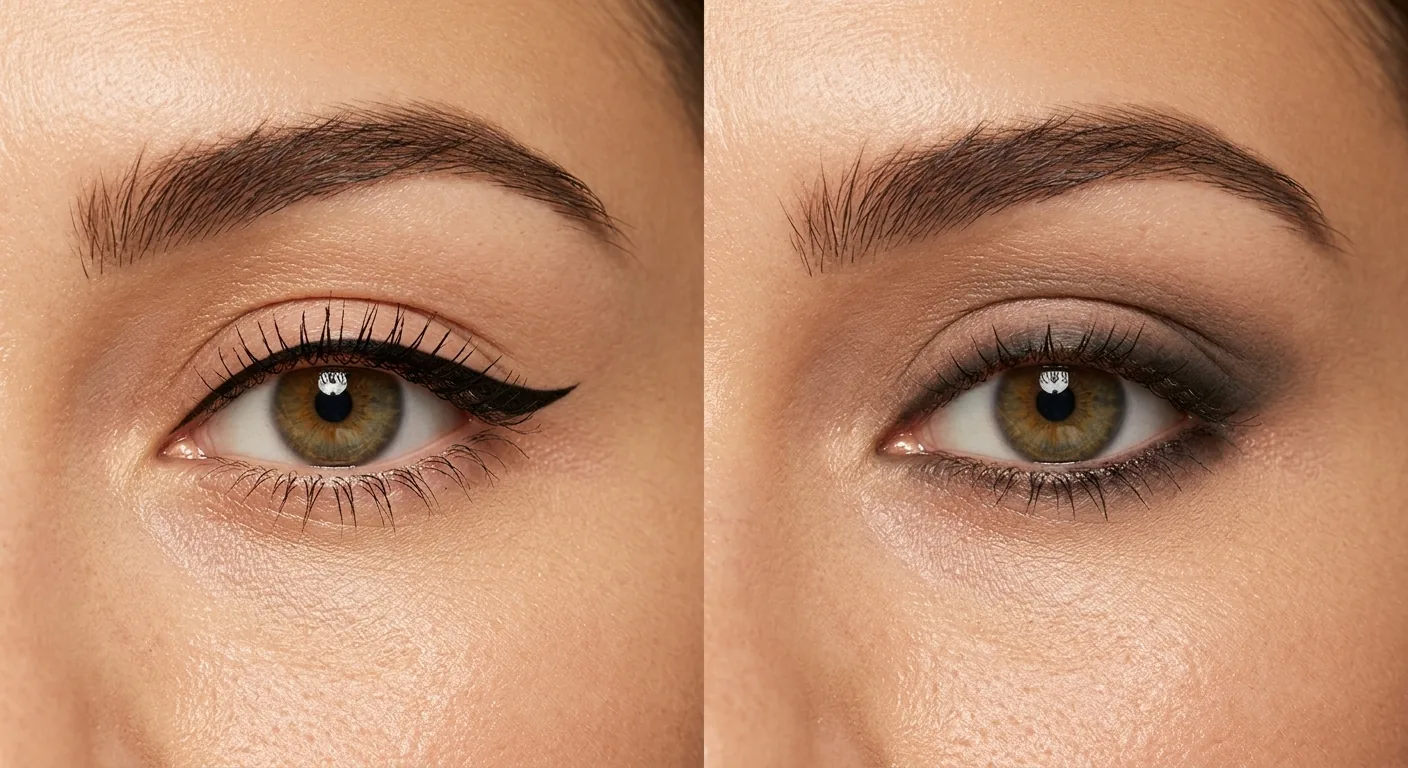
Choosing between classic and shaded eyeliner tattoo in Dubai is less about which one is "better" and more about which one flatters your specific eye shape. A hooded lid loses half of a thin classic liner the moment the brow drops over the lash line, while the same hooded lid frames a softly shaded gradient beautifully. A round, wide-open eye carries a bold classic line without looking heavy, but the same line on a small almond eye can crowd the lid and shorten the visible eye area. Our full shaded vs classic comparison covers technique and cost side by side; this guide is focused on the eye-shape matching that determines whether you will love or regret the result.
This Dubai 2026 guide maps the four most common eye shapes — almond, hooded, round, and monolid — to the technique that flatters each one, explains why the same line looks dramatic on one shape and disappears on another, breaks down healing and longevity differences between the two techniques, and flags the eye conditions (very deep-set, very protruding, lash ptosis) where one technique clearly outperforms the other. If you are weighing the broader eyeliner tattoo options, our shaded eyeliner service page shows the gradient technique in detail.
Why Eye Shape Matters More Than Trend
Eyeliner tattoo sits between the lashes and the crease. The shape of the eye and the position of the crease determine how much of the liner is visible at any moment, how the liner ages as the lid changes over the years, and whether the liner makes the eye look bigger, smaller, lifted, or heavier. Two clients asking for "the same liner" can end up with dramatically different results because their eye shapes interact with the pigment in opposite ways.
Classic liner is a single, crisp line of pigment. Every millimetre of that line is visible at all times. Shaded liner is a gradient that fades from dark at the lash line to soft above. Only the dark base of the gradient is visible; the upper portion is meant to blend into the skin. The visibility profile of these two techniques is fundamentally different, and that difference is what makes one technique right for some eye shapes and the other right for different ones.
The Four Eye Shapes We See Most in Dubai
Dubai's client base is genuinely global, so the four shapes below cover about 90% of what walks into our studio. Most clients recognise themselves in one or two of these descriptions.
Almond Eyes
Almond eyes have a visible lid space above the lashes, a slight upward lift at the outer corner, and a balanced proportion between the iris and the whites of the eye. They are the most versatile eye shape for eyeliner tattoo — almost every technique looks flattering. Both classic and shaded liner work well, and the choice comes down to the desired finish: crisp definition for a polished everyday look, or a soft gradient for a smoky, modern finish.
Hooded Eyes
Hooded eyes have a fold of skin that drops over the crease, covering part or most of the visible lid space. The lash line is partially hidden by the hood when the eye is open. This is the eye shape where classic liner is most likely to disappoint — a thin classic line hides under the hood, while a thicker line transfers onto the hood skin as the eye blinks, creating a smudgy "stamped" look within months. Shaded liner is the better match because the gradient blends upward into the hood rather than transferring onto it.
Round Eyes
Round eyes have a wide, circular visible iris with significant white showing above and below. They tend to look "wide open" and sometimes read as surprised. A bold classic liner elongates a round eye and adds sophistication; a thin classic liner can look juvenile. Shaded liner works but is less transformative on round eyes than classic liner because the eye already has the dimension that shading adds. Round eyes are the strongest case for classic.
Monolid Eyes
Monolid eyes have little to no visible crease between the lash line and the brow bone. The lid is one continuous plane from lash to brow. Classic liner applied thinly disappears against the flat lid; applied thickly, it reads as heavy. Shaded liner is the natural match for monolids because the gradient adds the dimension that the lid itself lacks — soft smoke that visually creates depth where the crease would be on a creased eye.
Classic vs Shaded Eyeliner Tattoo: How Each Technique Behaves
Both techniques are applied with a digital tattoo machine and pigment implant into the upper dermal layer. The difference is in the needle configuration, the number of passes, and the final saturation profile.
Classic Eyeliner Tattoo: The Clean Lash-Line Definition
Classic eyeliner is a single, crisp line of pigment applied with a 1-round or 3-round needle cartridge in one to two passes. The line is uniform in thickness from inner to outer corner unless the artist tapers it deliberately. Thickness varies from 1mm (a tight lash enhancement) to 3mm (a bold cat-eye) depending on the client's preference and lid space. Classic liner heals as one uniform scab and tends to hold saturation evenly along its length.
Shaded Eyeliner Tattoo: The Soft Powdered Gradient
Shaded eyeliner is a gradient where pigment is densest at the lash line and fades softly upward. The artist uses a 3-round to 7-round needle cartridge in two to three passes, building density at the lash line and lighter density above. The result heals as a soft powder effect, similar to softly applied eyeshadow. Shaded liner ages more gracefully than classic because any fading blends into the gradient rather than creating a visible "gap" in a crisp line.
Matching Eye Shape to Technique: The Full Chart
Below is the decision matrix our artists use during consultation. It is a starting point — every eye has subtle variations that may shift the recommendation one way or the other — but it covers most cases clearly.
Almond Eyes
- Best technique: classic or shaded (both work beautifully)
- Why classic works: the visible lid space shows off a crisp line; the almond shape is balanced enough to carry any thickness
- Why shaded works: the gradient adds a smoky, modern finish that suits the naturally lifted almond shape
- Choose classic if: you want a polished everyday look with maximum definition
- Choose shaded if: you want a softer, more modern finish or you wear smoky eye makeup often
Hooded Eyes
- Best technique: shaded (clear winner)
- Why classic struggles: the hood covers most of the liner when the eye is open; a thick classic line transfers onto the hood skin as the eye blinks, creating smudging within 6 to 12 months
- Why shaded works: the gradient blends upward into the hood rather than transferring onto it; the lash-line density stays visible while the upper portion fades naturally into the lid
- Choose shaded if: you have a moderate to deep hood (the deeper the hood, the stronger the case for shaded)
- Choose classic only if: your hood is mild and you want a tight lash enhancement (1mm thickness) that does not extend above the lash line
Round Eyes
- Best technique: classic (clear winner)
- Why classic works: a bold classic line elongates the round shape and adds a sophisticated, almond-like finish; the eye already has the dimension that shading adds, so the additional softness is less transformative
- Why shaded is acceptable: a soft gradient on a round eye looks polished but does not transform the shape the way classic does
- Choose classic if: you want maximum elongation and definition; a 2mm to 3mm thickness is typical
- Choose shaded if: you want a smoky effect and do not need shape transformation
Monolid Eyes
- Best technique: shaded (clear winner)
- Why classic struggles: a thin classic line disappears against the flat lid; a thick classic line reads as heavy and dated
- Why shaded works: the gradient creates the visual depth that the lid itself lacks; soft smoke defines the eye without the heaviness of a thick line
- Choose shaded if: you want a modern, dimensional finish
- Choose classic only if: you want a bold graphic line and accept the heavier aesthetic (works as a deliberate style choice, not as a flattering default)
Special Cases: Eye Shapes That Need Extra Thought
Beyond the four main shapes, a few conditions change the recommendation enough to flag them separately. These are not "bad" eyes for eyeliner tattoo — they just need a specific technique match to avoid common disappointments.
Deep-Set Eyes
Deep-set eyes sit further back in the brow bone, with the brow ridge casting a slight shadow over the lid. A thick classic liner can deepen the shadow and make the eye look smaller. Shaded liner is the better match because the gradient lifts visually and prevents the eye from looking recessed. Choose a soft, medium-density shaded application rather than a heavy one.
Protruding Eyes
Protruding eyes sit forward in the socket, with the lid more visible from the side than typical. A thin classic liner can look stark against the visible lid space. Shaded liner in a medium gradient softens the lid and adds balance. Avoid very bold classic lines on protruding eyes — they exaggerate the forward position.
Lash Ptosis or Sparse Lashes
Clients with lash ptosis (drooping lashes) or naturally sparse lashes benefit most from a shaded lash enhancement — a very soft gradient that hugs the lash line without extending visibly above it. This adds the appearance of lash density without looking like obvious liner. Our permanent eyeliner tattoo service includes a lash enhancement option for exactly this case.
Asymmetry Between Eyes
Most clients have slight asymmetry between the two eyes — one hood deeper than the other, one slightly more lifted than the other. Our artists measure and map each eye separately before applying any pigment. The technique is chosen per eye in cases of significant asymmetry: classic on the more lifted eye, shaded on the deeper-hood eye, balanced to look symmetrical when the eyes are at rest.
Healing, Longevity, and Touch-Up: What Differs Between the Two
Both techniques heal across 10 to 14 days and require a perfect-perfection touch-up at 6 to 10 weeks. The visible differences in healing are minor, but the longevity differs in a meaningful way.
Healing Time
Classic liner heals faster (7 to 10 days to surface recovery) because the scab is uniform and thin. Shaded liner heals in 10 to 14 days because the gradient scab is thicker and sheds unevenly across the gradient. Both techniques fully stabilise in pigment by Week 6.
Longevity in Dubai
Classic liner in Dubai fades unevenly along its length — the inner corner fades first (oilier skin, more tear duct moisture), the centre holds longest, the outer corner fades second. After 18 to 24 months, a classic line often shows a visible gap in the inner corner and outer corner while the centre remains crisp. Shaded liner fades as a gradient everywhere — no visible gaps, just a softer overall result after 18 to 24 months. Shaded is more forgiving as it ages.
Color Refresh
Classic liner needs a refresh every 12 to 18 months. Shaded liner needs a refresh every 18 to 24 months because the soft fade pattern is less visible as it ages. The refresh cost is similar for both techniques (500 to 900 AED at DHA-licensed Dubai studios).
Cost Comparison: Classic vs Shaded Eyeliner Tattoo in Dubai (2026)
Pricing in Dubai varies by studio location, artist experience, and what is included in the package. The 2026 numbers below reflect what DHA-licensed studios with master artists charge.
Classic Eyeliner Tattoo Dubai Price
- 1mm lash enhancement: 800 to 1,200 AED
- 2mm classic line: 1,000 to 1,500 AED
- 3mm bold classic with wing: 1,200 to 1,800 AED
Shaded Eyeliner Tattoo Dubai Price
- Soft lash-line gradient: 1,000 to 1,500 AED
- Medium smoky shaded: 1,200 to 1,800 AED
- Full smoky eye effect: 1,500 to 2,200 AED
Shaded liner runs 10% to 20% more than classic at most studios because it takes longer to apply (more passes, more density building) and requires more artistic precision. Both techniques include the perfect-perfection touch-up at 6 to 10 weeks in the standard price at reputable studios.
What to Bring to Your Consultation
A useful consultation covers more than just technique selection. Bring the following so your artist can give a specific recommendation for your eye shape:
- Photos of your eyes with no eye makeup. Natural photos show the artist your actual lid space, hood depth, and lash line. Makeup photos are useful for showing the look you want but do not show the canvas.
- Photos of liner looks you have saved. Pinterest boards, Instagram saves, or magazine cutouts all help the artist understand the finish you are aiming for.
- Your typical eye makeup routine. If you wear eyeshadow daily, you may already have an implicit preference for shaded finish. If you wear only mascara and tight-liner, classic may suit your habits better.
- Your age and any recent changes. Hood depth increases with age as the brow descends. A hood that was mild at 30 may be moderate at 45, changing the recommendation.
Common Mistakes to Avoid When Choosing
Most client disappointment with eyeliner tattoo comes from one of three decisions. None of them are catastrophic — all can be corrected at the perfect-perfection touch-up — but avoiding them saves you months of living with a look you do not love.
Choosing the Trend Instead of the Shape
Shaded smoky liner is the current trend in Dubai, but it is not right for every eye. A round eye wearing smoky shaded loses the elongation that classic would have given it. Match the technique to the shape first, the trend second.
Going Too Thin on Classic
A 1mm classic lash enhancement looks delicate in the chair but ages into invisibility within 12 to 18 months on most eye shapes. If you choose classic, choose 1.5mm to 2mm — it looks polished on Day 1 and still has visible presence at Month 18.
Going Too Heavy on Shaded
A full smoky shaded effect is dramatic on Day 1 but reads as heavy in everyday Dubai life (gym, office, beach). A medium shaded gradient — visible density at the lash line, soft fade above — wears better in most contexts.
Booking Your Eyeliner Tattoo at Brows and Lips Dubai
At Brows and Lips Dubai, eyeliner tattoo is performed by master artists with 5+ years of eye-specific PMU experience. The consultation includes lid analysis, technique recommendation based on your specific eye shape, pigment shade selection, and pre-procedure mapping. The first session takes 1.5 to 2 hours; the perfect-perfection touch-up at 6 to 10 weeks takes 60 to 90 minutes.
Both classic and shaded techniques include the touch-up in the standard price. We match the technique to your eye shape, not to the current trend — if classic is right for your round eyes, we recommend classic even if shaded is the more popular request this month.
Remember: Eye shape is the first filter for choosing between classic and shaded eyeliner tattoo. Hooded and monolid eyes are almost always better served by shaded; round eyes are almost always better served by classic; almond eyes can wear either beautifully. Bring natural photos of your eyes to the consultation, and let the artist recommend the technique that flatters your specific canvas.
Remember: Eye shape is the first filter for choosing between classic and shaded eyeliner tattoo in Dubai. Hooded and monolid eyes are almost always better served by shaded; round eyes by classic; almond eyes can wear either. Match technique to canvas, not to trend.