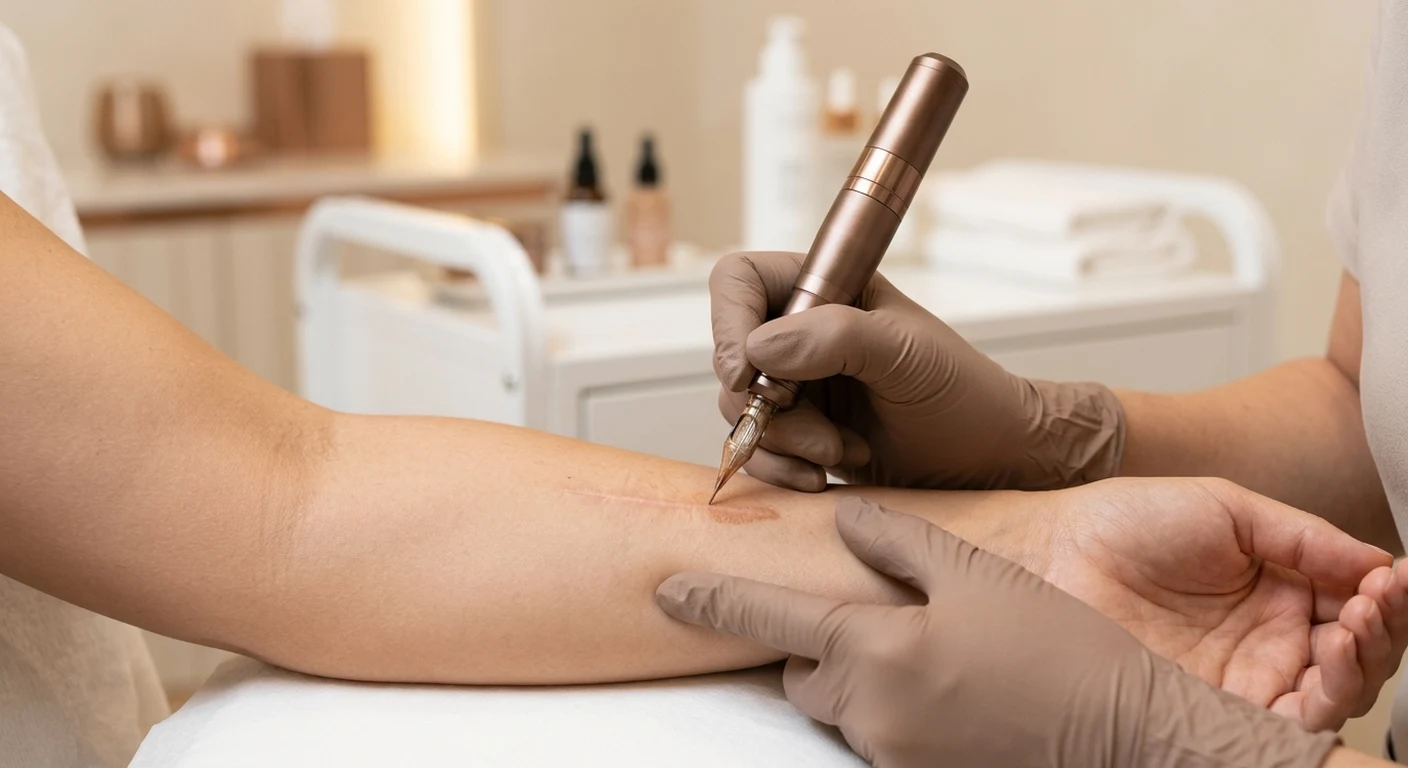
Most surgical scars are formed in childhood, teenage years, or in early adulthood — appendectomies, knee surgeries, C-sections, abdominoplasty, tumour removals, accident repair. They are not fresh. They have been there for years. They have flattened, faded to white or silver, sometimes stretched with weight change, sometimes puckered. They are part of the body, but they are also the visible reminder of something difficult. Scar camouflage for old surgical scars Dubai treatments at DHA-licensed medical PMU studios are designed for exactly this kind of long-healed tissue — they use skin-tone-matched pigment to soften the visual contrast between the scar and the surrounding skin.
This guide covers the full picture: how paramedical tattooing works on long-healed surgical scars, who is a good candidate, what kind of scar responds best, the procedure itself, healing timeline, how many sessions to expect, what results look like at 3, 6, and 12 months, 2026 cost in Dubai, aftercare specific to old scar tissue in Dubai heat, and the difference between scar camouflage, scar revision surgery, and laser scar treatment. For the standalone treatment page with before-and-after cases and booking, see our scar camouflage service page.
Why Old Surgical Scars Are Different from Fresh Scars
The biology of an old surgical scar is fundamentally different from a fresh one. A scar less than 6 months old is still in the remodelling phase — collagen is still being laid down, blood vessels are still reorganising, the scar is still changing colour and shape. A scar older than 12 months has finished its biological remodelling. It has reached its final colour (usually pale white, silver, or slightly pink), its final texture (flat, slightly raised, or slightly stretched), and its final shape. Pigment implanted into an old scar behaves very differently from pigment implanted into fresh tissue: the scar accepts colour more uniformly, holds it longer, and shows less shift during healing.
This is exactly why scar camouflage tattooing works best on scars that are at least 12 months old, ideally 18 to 24 months old. The tissue has settled, the collagen has matured, and the blood supply has stabilised. Pigment stays where the artist places it. There is no risk of interfering with natural healing. The scar is biologically a stable surface — it just looks different in colour and sometimes texture from the surrounding skin, which is precisely what pigment camouflage is designed to address.
What This Guide Covers
- How paramedical tattooing works on old scars — pigment depth, layering, colour matching.
- Who is a good candidate — scar age, scar type, skin tone considerations.
- What kinds of old surgical scars respond best — flat, mature, hypopigmented scars respond best.
- The procedure — consultation, colour matching, numbing, the pigmentation pass.
- Healing timeline in Dubai heat — day-by-day what to expect.
- How many sessions — typical 2 to 4 sessions depending on scar and skin.
- Results over 12 months — what the scar looks like at 3, 6, and 12 months.
- Cost in Dubai — 2026 price ranges and what affects them.
- Aftercare specific to Dubai climate — sun, sweat, pool, sauna.
- Scar camouflage vs scar revision surgery vs laser — when each option is right.
- FAQ — top 7 questions Dubai clients ask before booking.
How Paramedical Tattooing Works on Old Surgical Scars
Paramedical tattooing (also called medical tattooing, scar camouflage tattooing, or skin-tone tattooing) is a non-surgical pigment treatment that uses a digital tattoo machine or hand tool to deposit custom-blended pigment into the upper dermal layer of mature scar tissue. The pigment is matched to the client's surrounding skin tone — not the scar colour — so when it heals into the scar, the contrast between scar and skin reduces, and the scar visually blends with the body.
Unlike decorative tattooing, the pigment is custom-mixed at the appointment from a base palette of skin tones. A trained medical PMU artist mixes multiple pigments in front of the client to build an exact match for that specific area — chest scar on olive skin, knee scar on fair skin, abdominal scar on tan skin. The match is held up against the skin in natural daylight and adjusted until it disappears into the surrounding skin.
Once matched, the pigment is implanted into the scar tissue in multiple thin layers. Each layer adds a small amount of colour. Between layers the artist steps back, checks the colour against the skin, and decides whether to deepen, lighten, warm, or cool the tone. The work is slow, methodical, and conservative — a scar camouflage tattoo is not finished in one pass, it is built up over 2 to 4 sessions spaced 6 to 8 weeks apart.
Why Old Surgical Scars Accept Pigment Better Than Fresh Scars
Mature scar tissue has stabilised collagen and stable blood supply. Pigment implanted into mature scar tissue stays where it is placed, holds its colour shift predictably during healing, and settles into a long-term result that does not fade unpredictably. A fresh scar (less than 12 months old) is still remodelling — collagen is still being laid down and broken down, blood vessels are still reorganising, the scar colour is still changing month to month. Pigment placed into a fresh scar can shift, fade unevenly, or even be pushed out as the tissue continues to remodel. This is why reputable Dubai studios will not perform scar camouflage on a scar less than 12 months old — the result is unpredictable.
Who Is a Good Candidate for Old Surgical Scar Camouflage
Not every old scar is right for camouflage tattooing. The treatment works best on a specific set of scar characteristics, and a good Dubai studio will assess all of these during a free consultation before booking.
Scar Age: Minimum 12 Months, Ideally 18–24 Months
The scar must be fully healed and biologically mature. A scar that is still pink, red, raised, itchy, or changing is still in the remodelling phase — camouflage is not safe or predictable yet. The standard rule is minimum 12 months from the surgery date, but 18 to 24 months gives better pigment retention and more predictable colour match.
Scar Type: Flat, Hypopigmented, or Atrophic
Scar camouflage works best on flat or slightly depressed (atrophic) scars that are lighter than the surrounding skin (hypopigmented) or the same tone but with visible textural difference. These include:
- Appendectomy scars — small horizontal scar on the lower right abdomen.
- C-section scars — horizontal scar across the lower abdomen (covered separately in our C-section scar camouflage guide).
- Abdominoplasty (tummy tuck) scars — long horizontal scar across the lower abdomen, often hip to hip.
- Knee and joint surgery scars — from ACL repair, meniscus surgery, fracture plates.
- Tumour or mole removal scars — small to medium circular or oval scars.
- Accident repair scars — from cuts, lacerations, surgical repair of trauma.
- Thyroidectomy scars — horizontal scar on the lower neck.
- Breast surgery scars — from lumpectomy, reduction, augmentation.
What Scars Do NOT Respond Well to Camouflage Tattooing
- Hypertrophic or keloid scars — raised, thickened, red scars. Camouflage pigment can be added but the texture difference remains. These scars often need steroid injection or laser first.
- Still-red or pink scars — vascular, still-healing scars need to mature first.
- Scars less than 12 months old — pigment retention is unpredictable.
- Very dark or hyperpigmented scars — camouflage lightens by adding matching tone, but cannot lighten a darker scar to match lighter skin. Laser or chemical peel first, then camouflage.
- Scars with active infection, open wounds, or skin disease in the area — treatment must wait.
The Old Surgical Scar Camouflage Procedure at a Dubai Studio
A scar camouflage tattoo appointment at a DHA-licensed Dubai medical PMU studio follows a clear protocol. The whole process from consultation to final result takes 4 to 6 months because of the layered, multi-session approach.
Step 1 — Free Consultation and Scar Assessment
The first appointment is a 30 to 45-minute consultation. The medical PMU artist examines the scar in natural daylight, assesses its age, type, texture, and colour, and discusses your medical history (any history of keloid scarring, recent isotretinoin use, autoimmune conditions, or radiotherapy in the area). The artist also assesses the surrounding skin tone — what colour the scar needs to become to blend. You leave the consultation with a clear recommendation: scar camouflage is suitable, you need to wait X months, or the scar is not suitable and an alternative (laser, steroid, revision surgery) is recommended.
Step 2 — First Camouflage Session (2 to 3 Hours)
The first pigmentation session is the longest. The artist:
- Takes baseline photographs of the scar in standardised lighting for your file.
- Cleans the area with medical-grade antiseptic.
- Custom-mixes pigment in front of you to match your surrounding skin tone.
- Applies topical anaesthetic (numbing cream) for 20 to 30 minutes.
- Implants the first layer of pigment into the scar in a stippling pattern, working section by section.
- Builds up multiple thin passes, checking colour match against surrounding skin between passes.
- Takes post-procedure photographs.
- Applies a sterile dressing and walks you through aftercare.
The first session achieves roughly 50 to 70% of the final colour result. The scar will look noticeably softer and more blended immediately, but the true colour match settles over the next 6 to 8 weeks as the pigment heals.
Step 3 — Healing and Waiting Period (6 to 8 Weeks)
The scar heals over 6 to 8 weeks. During this time the pigment softens, settles into the tissue, and the colour stabilises. You will see the scar look darker for the first 10 to 14 days (this is the surface pigment that exfoliates), then lighter than expected for weeks 3 to 5 (the deeper pigment is still integrating), and finally the true settled colour emerges by week 6 to 8.
Step 4 — Second Camouflage Session (1.5 to 2 Hours)
The second session refines and deepens. The artist assesses how the pigment healed, where it faded more than expected, where the colour shifted, and adds a second layer to bring the scar closer to perfect match. Most old surgical scars need 2 to 4 sessions total, depending on scar size, scar age, skin type, and sun exposure history.
Step 5 — Final Result and Maintenance Plan
After the final session, the scar is photographed in standardised lighting and compared to baseline. You leave with an aftercare plan for the next 8 weeks, a long-term maintenance plan (sunscreen, no harsh exfoliation on the area, occasional touch-up if needed), and a recommended follow-up schedule (typically a check-in at 6 months and a touch-up if needed at 12 months).
Healing Timeline for Old Surgical Scar Camouflage in Dubai Heat
Dubai's heat, sun, humidity, and air-conditioning all affect how a camouflaged scar heals. The timeline below is what a typical Dubai client experiences for an old surgical scar on the abdomen, thigh, knee, or arm.
Days 1–3: Fresh and Dark
The scar looks darker than the final result will be — this is the surface pigment that has not yet settled into the dermal layer. The area feels tight, slightly tender, and may have minor pinpoint redness around the pigment. No real pain. Keep the area clean, dry, and covered with the sterile dressing provided. Avoid hot showers, sweating, swimming, saunas, and direct sun. Stay indoors in air-conditioning as much as possible.
Days 4–10: Flaking and Lightening
The surface pigment begins to flake off naturally — do not pick, scratch, or exfoliate. The scar will look much lighter than expected, sometimes almost as if nothing was done. This is normal. The pigment is still in the deeper dermal layer; the surface is just shedding the excess. Continue gentle cleaning, no scrubbing, no swimming, no sun.
Days 11–21: Settling and True Colour Emerging
The pigment settles into the scar and the true colour match starts to emerge. By day 21, most clients see roughly 70 to 80% of the final colour result. The scar looks softer and more blended with the surrounding skin. You can usually resume most normal activities except direct sun exposure, which must still be avoided for 8 to 12 weeks.
Weeks 4–8: Final Settled Result
By week 6 to 8, the pigment has fully settled and the colour has stabilised. The scar is noticeably less visible — not invisible, but the colour and texture difference is significantly reduced. The final result of session one is in. This is when the artist assesses whether session two is needed and what areas to deepen.
How Many Sessions an Old Surgical Scar Typically Needs
Most mature surgical scars need 2 to 4 sessions of camouflage tattooing to reach a near-perfect blend. The exact number depends on scar size, scar location, scar age, surrounding skin tone, sun exposure history, and how the pigment heals in your specific tissue.
Typical Session Count by Scar Type
- Small appendectomy or mole-removal scar (under 5 cm) — typically 2 sessions.
- Medium C-section or knee surgery scar (5 to 15 cm) — typically 2 to 3 sessions.
- Long abdominoplasty or thigh lift scar (over 15 cm) — typically 3 to 4 sessions.
- Old burn or accident scar (irregular shape) — typically 3 to 4 sessions, sometimes more.
- Thyroidectomy or breast surgery scar (small, flat) — typically 2 sessions.
Spacing Between Sessions
Sessions are spaced 6 to 8 weeks apart to allow full healing between passes. This means a complete scar camouflage treatment takes 4 to 6 months from first session to final result. Most Dubai clients book the first session during cooler months (October to March) so the long healing window is not spent in peak summer heat, but it can be done year-round with proper sun protection.
Results Over 12 Months: What Old Surgical Scars Look Like at 3, 6, and 12 Months
Scar camouflage is permanent but evolves over time. The settled result at week 8 is not the final result at 12 months — pigment continues to soften, integrate, and slightly fade over the first year. Here is what to expect at each milestone.
At 3 Months Post-Final Session
The scar is significantly less visible. The colour match is close but not perfect — there may still be a faint tonal difference between the scar and the surrounding skin. Texture difference (if any) is unchanged because camouflage addresses colour, not texture. Most clients feel comfortable wearing clothing that exposes the area (bikini, shorts, sleeveless top) for the first time in years.
At 6 Months Post-Final Session
The pigment has fully integrated with the surrounding skin tone. The colour match is at its best. The scar is barely noticeable in casual social settings and often invisible in photographs unless the lighting is very direct. Many clients report they have stopped actively thinking about the scar in daily life.
At 12 Months Post-Final Session
Very slight softening of the pigment (10 to 15% lighter than at 6 months) is normal, especially in sun-exposed areas (arms, chest, face, neck). With strict daily sunscreen, the pigment can hold its colour well past 12 months — 3 to 5 years is typical for body scars, 2 to 4 years for sun-exposed scars. A touch-up session at 12 to 24 months can refresh the colour.
Cost of Old Surgical Scar Camouflage in Dubai (2026)
Scar camouflage is priced per session in Dubai, and the total cost depends on the size of the scar, the number of sessions needed, and the studio's reputation and location. Below are typical 2026 ranges at DHA-licensed medical PMU studios in Dubai.
Price Ranges by Scar Size
- Small scar (under 5 cm, e.g. appendectomy, mole removal): AED 800 to 1,200 per session, typically 2 sessions.
- Medium scar (5 to 15 cm, e.g. C-section, knee surgery): AED 1,200 to 1,800 per session, typically 2 to 3 sessions.
- Long scar (over 15 cm, e.g. abdominoplasty, thigh lift): AED 1,800 to 2,500 per session, typically 3 to 4 sessions.
- Multiple small scars (e.g. several mole removals, laparoscopic ports): AED 1,500 to 2,000 for the first session (covering all scars), AED 1,000 to 1,500 for follow-up sessions.
- Irregular or burn scar (custom quote): AED 2,000 to 3,500 per session, depending on size and complexity.
What Affects the Price
- Scar size: the bigger the area, the more pigment and time.
- Scar location: scars on curved or mobile areas (joints, abdomen) take longer than flat, stable areas.
- Skin tone complexity: very fair, very dark, or undertone-complex skin requires more pigment-mixing time.
- Studio reputation: senior medical PMU artists with paramedical training charge more than junior artists.
- Number of sessions: most studios offer package pricing for 3 or 4 sessions, reducing per-session cost.
Aftercare for Old Surgical Scar Camouflage in Dubai Climate
Aftercare in Dubai is more strict than in cooler climates because heat, sun, sweat, and pool water all interfere with pigment settling. The aftercare protocol below is what we give every scar camouflage client at our Al Wasl Road studio.
First 14 Days: Strict Protection
- Keep the area clean and dry — gentle cleanse with mild unscented soap, pat dry, do not rub.
- Apply the aftercare balm provided 2 to 3 times a day for 7 to 10 days.
- No sweating — no gym, hot yoga, running, or any activity that causes perspiration in the area.
- No swimming — no pool, sea, jacuzzi, sauna, or steam room.
- No direct sun — keep the area fully covered with clothing or a medical dressing.
- No picking or scratching — let any flaking fall off naturally.
- No harsh products — no exfoliants, retinoids, vitamin C serums, or acids on the area.
- Loose clothing only — tight waistbands or seams can rub the pigment out.
Weeks 3–8: Sun Avoidance and Continued Care
- Strict SPF 50+ sunscreen on the area every day, reapply every 2 hours if exposed.
- Physical sun protection — clothing, rash guards, or medical tape over the scar if it will be exposed.
- No tanning beds — UV exposure fades camouflage pigment dramatically.
- Avoid abrasive clothing on the area for the full 8 weeks.
- Stay hydrated — Dubai's dry air and air-conditioning dehydrate healing skin.
Long-Term Maintenance: Protect the Result
- Daily SPF 50+ on the scar for life — sun exposure is the single biggest cause of pigment fade.
- Avoid harsh exfoliation on the scar (no scrubs, no strong retinoids, no chemical peels directly on the pigment).
- Avoid laser hair removal directly on the camouflaged scar — laser can break down the pigment.
- Annual check-in with your medical PMU artist to assess if a refresh is needed.
Scar Camouflage vs Scar Revision Surgery vs Laser Scar Treatment
Scar camouflage tattooing is one of three common approaches to old surgical scar improvement. The right choice depends on what is bothering you about the scar: the colour, the texture, or both.
Choose Scar Camouflage If
The scar is the right colour, but it is too white, too pale, too light, or visibly different in tone from the surrounding skin. The texture is acceptable (flat or close to flat). You want a non-surgical, walk-in walk-out treatment. You are willing to commit to 2 to 4 sessions and 4 to 6 months of healing.
Choose Scar Revision Surgery If
The scar is wide, puckered, raised, or visibly misaligned with skin tension lines. The colour is also an issue but the bigger concern is the texture and shape. You are willing to undergo a second surgery (with its own recovery, cost, and scar) and wait 12 to 18 months before any camouflage tattoo. Often revision surgery is followed by camouflage tattooing for the best result.
Choose Laser Scar Treatment If
The scar is red, pink, or hyperpigmented (darker than surrounding skin). Lasers can address vascular colour (redness) and stimulate collagen remodelling for texture. Camouflage tattooing can be added after laser to refine the colour match once the scar is no longer red. For Dubai laser scar options, see our scar camouflage service page for the full medical PMU and laser combination protocol.
Can You Combine Treatments?
Yes. Many Dubai clients do combination treatment: laser first to address redness or texture, then 6 to 12 months later, scar camouflage to refine the colour. Some also do scar revision surgery first, then wait 12 to 18 months, then camouflage. Combination approaches give the best results on complex old scars but require patience and a longer timeline.
FAQ: Old Surgical Scar Camouflage Dubai
1. Does scar camouflage hurt on old surgical scars?
Most clients describe the sensation as mild discomfort rather than pain. Old scar tissue has reduced nerve sensitivity compared to normal skin, so the area is often less sensitive than expected. Topical anaesthetic is applied for 20 to 30 minutes before the procedure, and most clients rate the pain 3 to 5 out of 10. Areas with thinner skin or closer to bone (knees, elbows) are slightly more sensitive than areas with thicker skin (abdomen, thigh).
2. Will the camouflage make the scar completely invisible?
No. Scar camouflage makes the scar significantly less visible — usually 70 to 90% improvement in the casual-observer test. A trained eye in very direct lighting may still detect a slight tonal or textural difference. The goal is blending, not erasure. Clients who expect 100% invisibility are usually disappointed; clients who expect a major visual reduction are almost always thrilled.
3. How long does old scar camouflage last?
Permanent, but evolving. Body scars (abdomen, thigh, back) typically hold pigment 3 to 5 years before a refresh is needed. Sun-exposed scars (chest, arms, neck, face) typically hold 2 to 4 years. Strict daily sunscreen is the single biggest factor in pigment longevity. A touch-up session at 12 to 24 months is common for sun-exposed scars.
4. Can you camouflage any colour scar?
Scar camouflage works by adding skin-tone pigment to the scar. It is best for scars that are lighter than the surrounding skin (hypopigmented). It is less effective for scars that are darker (hyperpigmented) — pigment cannot lighten a scar, only add colour to it. Hyperpigmented scars usually need laser or chemical peel first, then camouflage.
5. Is scar camouflage safe?
Yes, when performed at a DHA-licensed medical PMU studio using sterile single-use needles, medical-grade pigments, and proper hygiene protocols. The treatment is non-surgical, walk-in walk-out, and requires no general anaesthesia. Risks are minimal — minor infection (preventable with proper aftercare), allergic reaction to pigment (rare, patch test available), or unsatisfactory colour match (correctable in the next session). For our full safety and hygiene protocol, see the scar camouflage service page.
6. Can I do scar camouflage in Dubai summer?
Yes, but summer requires stricter sun avoidance during healing. Most Dubai clients prefer October to March for the long healing window because the sun is less intense and outdoor exposure is naturally lower. Summer camouflage is fine if you commit to strict SPF 50+ and physical sun protection for 8 to 12 weeks post each session.
7. What if my scar is from a surgery I am not comfortable disclosing?
You do not need to disclose the type or reason for your surgery to a medical PMU artist. Confidentiality is standard at DHA-licensed Dubai studios. Your file is private, your before-and-after photos are stored securely, and your artist works on the scar as a piece of tissue — not as a story. Many clients come in for scars they have never discussed with anyone, and the studio environment is built for that.
Book Your Old Surgical Scar Camouflage Consultation in Dubai
If you have a long-healed surgical scar that you would like softened, blended, and made less visible, the next step is a free 30 to 45-minute consultation at a DHA-licensed Dubai medical PMU studio. The artist will assess your scar's age, type, colour, and texture, custom-blend a pigment sample against your skin tone, and recommend whether scar camouflage is the right approach or whether laser, revision, or a combination is better. For our studio's full scar camouflage service, before-and-after cases, and booking, visit our scar camouflage service page or browse the related C-section scar camouflage guide, scar camouflage aftercare guide, and medical PMU overview article.