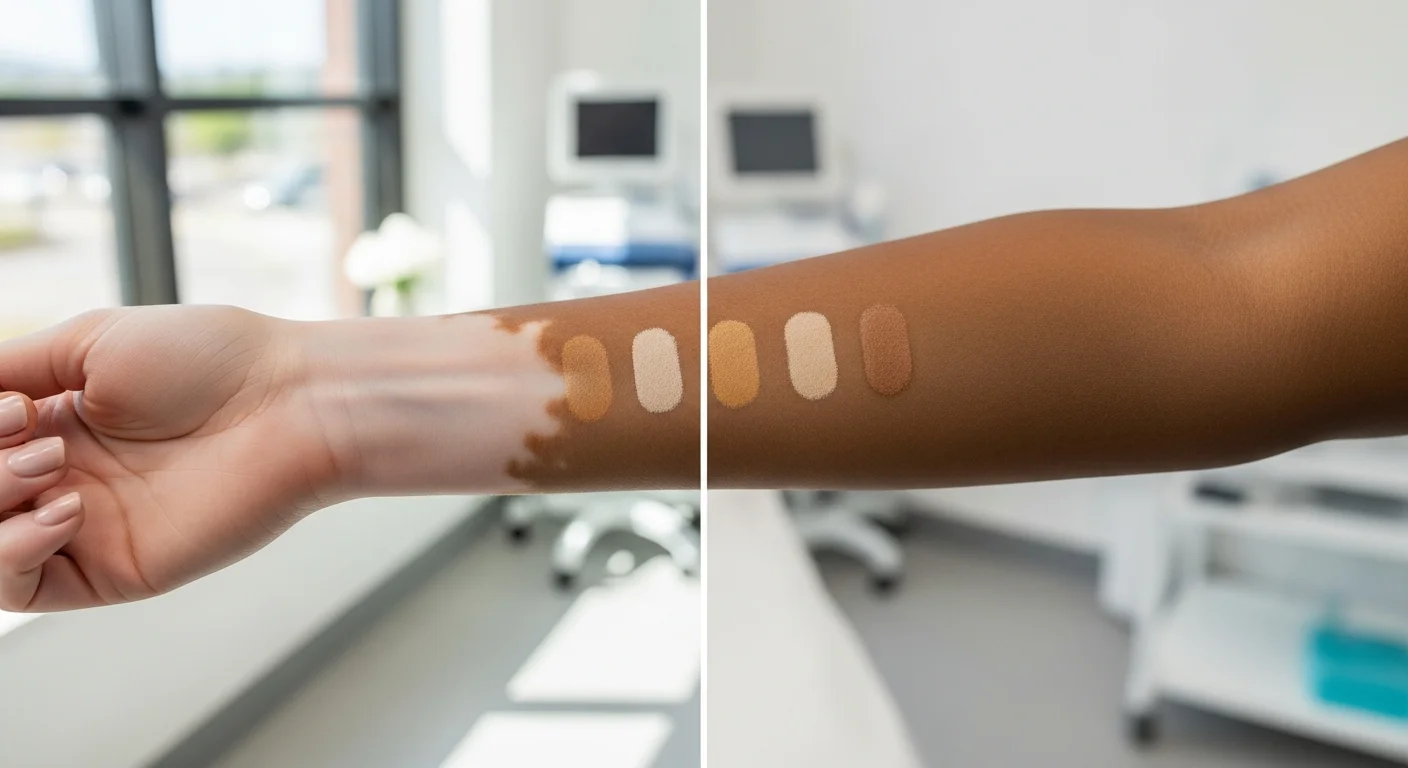
Getting the right colour match is the single most important factor in vitiligo camouflage tattooing. A perfect pigment blend makes white patches disappear against your natural skin tone. A poor match stands out and defeats the purpose of the procedure. At Brows and Lips Dubai, we have developed a systematic approach to pigment matching that works across all Fitzpatrick skin types — from very fair to deep ebony. This guide walks through the science and technique behind successful colour matching.
Why Pigment Matching Is Different for Vitiligo
Unlike cosmetic eyebrow tattooing where you have freedom to choose a shade, vitiligo camouflage is about exact replication of your existing skin colour. The challenge is that vitiligo patches sit next to normally pigmented skin, so any mismatch is immediately visible. The pigment must match the surrounding skin's hue, saturation, and undertone — not just the surface colour.
Another factor: vitiligo camouflage uses medical-grade iron-oxide pigments rather than the carbon-based pigments used in cosmetic tattooing. Iron oxides provide more natural, skin-like tones that blend rather than sit on top of the skin. They also fade more predictably over time, which matters for touch-up planning.
The Fitzpatrick Scale and Vitiligo Camouflage
Every vitiligo camouflage consultation at our Dubai studio starts with identifying your Fitzpatrick skin type. This six-level scale classifies skin by its response to UV exposure and determines how pigment will behave once deposited in the epidermis.
Type I-II (Very Fair to Fair Skin)
Light skin presents a specific challenge: the contrast between the white vitiligo patch and the surrounding skin is less dramatic than on darker skin, but the pigment must be very precisely matched because any deviation shows. On Fitzpatrick I-II skin, we use pigments with slightly pink or peachy undertones to mimic the natural vascular flush. The pigment concentration is kept lower to avoid an artificial "tattooed" look. Multiple light passes during the session produce a natural blend.
Type III-IV (Medium to Olive Skin)
This is the most common Fitzpatrick range we see in Dubai's diverse client base. Medium skin tones often have warm golden or neutral undertones. The pigment blend requires a careful balance of brown and yellow bases to match the natural complexion. Olive skin (type IV) may need slight green-neutralising notes in the pigment mix. For this range, we typically achieve a 90%+ match in the first session, with a touch-up session refining the remaining 10%.
Type V-VI (Brown to Dark Skin)
Dark skin requires the most sophisticated pigment blending. Vitiligo patches on Fitzpatrick V-VI skin stand out starkly — pure white against deep brown. The goal is not just colour matching but also undertone matching: dark skin has complex warm, red, or blue undertones that vary by individual. Our pigment library includes deep brown bases with adjustable red, orange, and violet modifiers. We mix custom blends in increments of 5% to fine-tune the match. The pigment must also be formulated to avoid ashiness or a grey cast when deposited.
Dark skin requires the most skill. The pigment must match both the colour and the undertone — warm, red, or neutral — to avoid a grey or ashy appearance. A consultation is essential to get this right.
The Colour Matching Process Step by Step
Step 1: Skin Analysis Under Natural Light
Colour matching is done under full-spectrum natural daylight, never under warm salon lighting that distorts undertones. Your practitioner examines the vitiligo patch and the surrounding skin from multiple angles. They assess three things: the base colour of the unaffected skin, the undertone (cool, warm, or neutral), and the opacity of the vitiligo patch (complete depigmentation vs partial pigment loss).
Step 2: Reference Swatching
We apply small test dots of pre-mixed pigment blends on the skin near the vitiligo patch, not on the patch itself. The test area is on the border zone — the transition area between normal skin and depigmented skin. This allows us to see how the pigment blends with the natural skin. The test dots are left for 5-10 minutes to allow slight oxidation, then evaluated for match.
Step 3: Custom Blend Formulation
Based on the swatch test, the practitioner adjusts the pigment formula. The adjustment can involve: changing the base pigment shade by one Fitzpatrick level, adding a colour corrector (peach for cool undertones, gold for warm), or diluting the pigment concentration for lighter coverage. Each custom blend is recorded in the client's file for future touch-up sessions.
Step 4: Layered Application
The pigment is deposited in fine layers rather than one heavy pass. This mimics how natural melanin sits in the skin — in layers of varying density. The first pass establishes the base colour. Subsequent passes adjust the depth and opacity. We wait 3-5 minutes between passes to let the pigment settle and check the colour before continuing.
Common Colour Matching Challenges
- Segmentally matched vitiligo — When patches appear on both sides of the face or body in a symmetrical pattern, each side may need a slightly different pigment blend because the skin's natural colour varies by location (e.g., jawline vs cheek)
- Body area variation — The skin on your hands is naturally slightly different from the skin on your face or torso. Vitiligo camouflage on hands often needs a cooler, slightly more translucent pigment because hand skin is thinner and shows vascular undertones more prominently
- Sun exposure mismatch — Tanned skin around a vitiligo patch creates a deeper contrast. We recommend doing colour matching when your skin is at its usual, non-tanned state, or we match to the tanned shade if you plan to maintain that colour
- Healing pigment shift — The pigment you see immediately after treatment is 30-40% darker than the final healed result. We account for this by matching slightly lighter than the surrounding skin, knowing it will settle to the correct shade within 2-4 weeks
- Multi-area treatment — If you have vitiligo patches on different body parts (e.g., face and hands), each area may need a separate pigment blend because skin tone varies across the body
Why Professional Matching Beats DIY Concealer
Many people with vitiligo have tried heavy concealers, colour-correcting creams, or self-tanning products to cover white patches. These solutions wash off, transfer to clothing, and need daily reapplication. Medical micropigmentation deposits pigment into the dermal layer where it stays until the skin naturally regenerates (2-5 years). The colour match is also more precise because we blend custom pigments for your exact skin tone rather than working with off-the-shelf concealer shades that cover a wide range but match none perfectly.
Maintaining Your Colour Match Over Time
- SPF protection — Sun exposure can cause the surrounding skin to tan while the treated vitiligo area remains unchanged, creating a ring of contrast. Daily SPF 50+ on treated areas prevents this
- Touch-up timing — Most clients need a refresh every 18-24 months. The pigment formula from the original session is on file, so the match is consistent
- Seasonal adjustment — If your skin naturally tans in summer and lightens in winter, you may need two slightly different pigment blends for different seasons. Some clients opt to match their winter shade and use gradual self-tanner on surrounding skin during summer
- Vitiligo progression check — If your vitiligo is active and new patches appear, the treated areas will still match their original surrounding skin, but new patches around them will need additional sessions
Colour matching is both an art and a science. The right pigment blend transforms vitiligo camouflage from a visible cover-up into an invisible restoration. Book a consultation at Brows and Lips Dubai to experience our precision matching process.